
KEY TAKEAWAYS
- Missing revenue targets is a symptom. A new CXO, a PE acquisition, or a missed earnings report is a trigger. Most B2B sales teams build their prospecting strategy around symptoms and wonder why nothing changes.
- Only 9–11% of a B2B company’s total addressable market is in-market for a new solution in any given quarter (6sense). Trigger intelligence is what determines whether you reach those buyers during the window when they’re forming preferences.
- The sales teams with the best trigger data are often the worst at converting it. They confuse the existence of a trigger with the buyer’s readiness to be sold to.
- A trigger gives permission to be present, not permission to push. Teams that treat the signal as a starting gun for aggressive outreach destroy the very opportunity the trigger created.
- Companies that intercept early without pushing, then build presence over time, are nearly impossible to displace once the buyer is ready to act.
A revenue leader looks at the dashboard and sees the same problems every quarter: thin pipeline coverage, low conversion rates, and poor deal quality with static rather than recurring billing and little room for growth.
The instinct is to treat the numbers themselves as the problem. But those numbers are the symptoms of a real problem happening upstream: a lack of understanding of which trigger events evolve into real and valuable deals over time.
WHAT COUNTS AS A TRIGGER
Trigger events are the moments that move a buyer from “fine as we are” to “we need to look at this.” They’re usually structural, sometimes quite public, and often trackable.
The most reliable triggers in enterprise B2B include:
- A new leader or senior decision-maker joining the company
- A missed earnings report or downward revision of guidance
- A private equity acquisition or change in ownership
- A regulatory shift that creates new compliance work
- A material shift in input pricing or supply chain (a semiconductor cost spike, a new tariff, a primary vendor losing capacity)
- A wave of hiring or layoffs in a specific function
- A leadership statement that signals strategic redirection
What unites these signals is that they don’t depend on the buyer telling you anything.
They’re observable in press releases, earnings calls, public filings, hiring data, and trade news. If a team is willing to do the watching, the watching pays off in the form of precision revenue interception and deal intelligence.
Source: Gartner 2025
MOST OF THE MARKET ISN’T BUYING
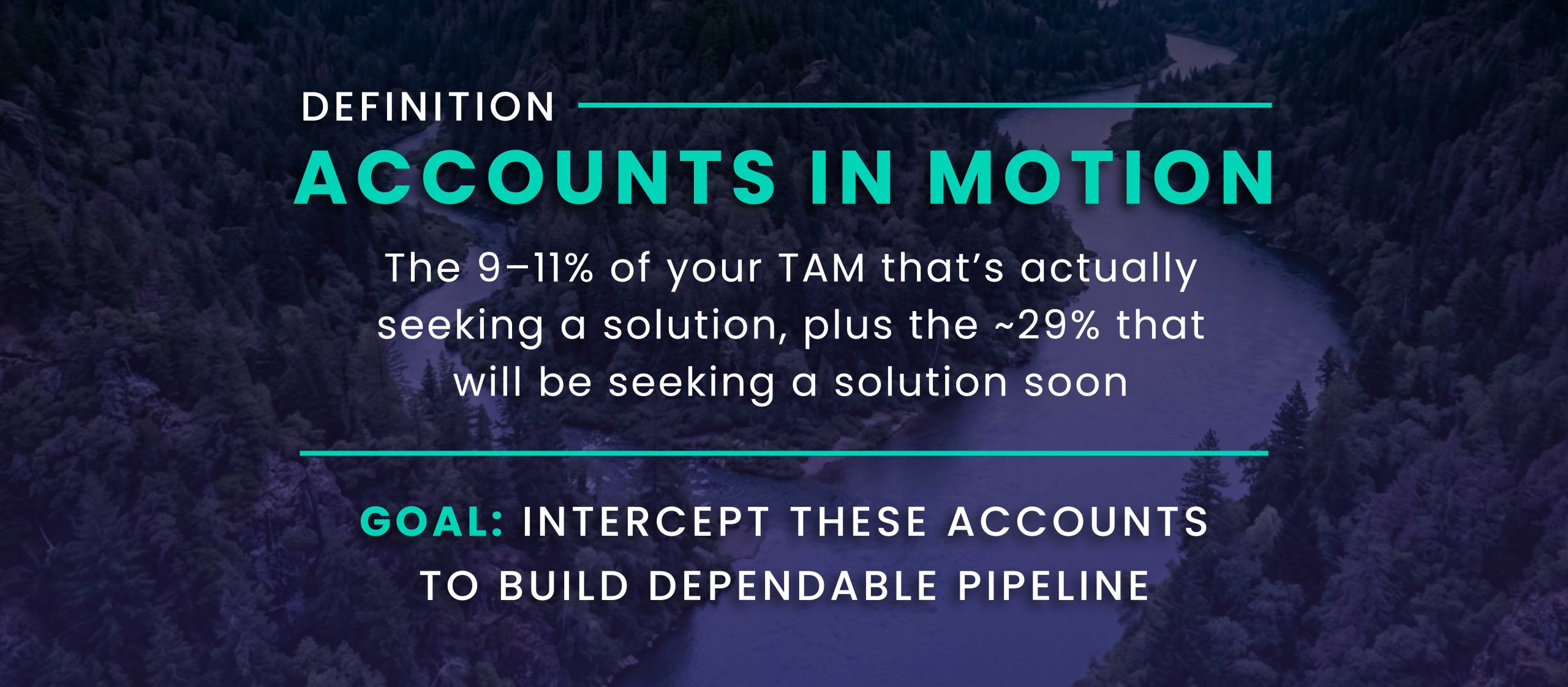
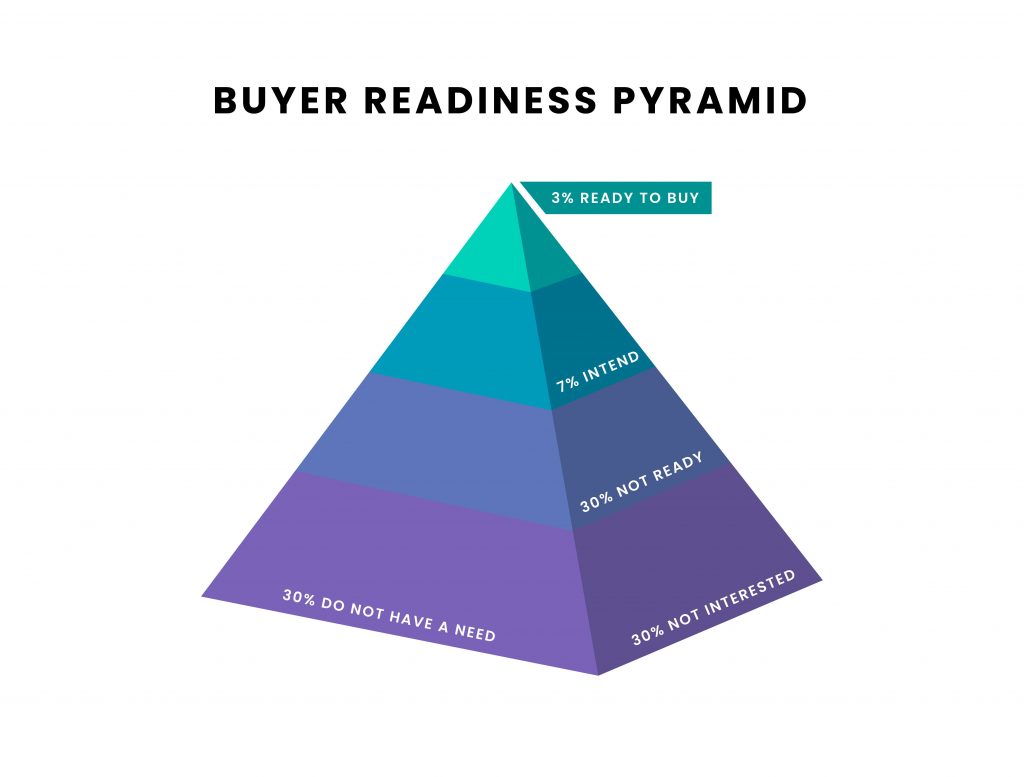
In any given quarter, only 9–11% of a B2B company’s total addressable market is actually seeking a new solution, according to a 6sense Research survey of 392 B2B organizations.
Source: 6sense 2023, About 10% of Your Potential Customers Are Ready to Buy This Quarter. Chances Are, You’re Missing Them.
Another segment, roughly 30% of the market, is getting ready to start shopping. These accounts haven’t entered active buying mode yet, but they’re moving in that direction, which means they respond to a different kind of outreach than the accounts already deep in a search.
Generic outreach to accounts that aren’t yet in motion produces predictable results: low reply rates, high complaint rates, and an eroded brand reputation that sours the account against your brand for years. The accounts approaching the market eventually need a different signal entirely, since treating them the same as a cold prospect or an active buyer wastes the early relationship you could be building.
Outreach to the 9–11% already seeking a solution carries its own problem. By the time most sellers reach those buyers, the buyer has already formed a preference. 6sense’s later research shows that the vendor a buyer favors before talking to any seller wins the deal roughly 80% of the time. Therefore, if you’re absent from that short list of preferred brands, you’re fighting an uphill battle before the first conversation even happens.
Source: 6sense 2024, The Critical Period for B2B Buying & the Seventy-Percent Solution
The window to influence preference opens at the trigger, and it closes quickly. Without trigger intelligence, teams are guessing when that window is open, and guessing means missing the accounts moving toward a decision until it’s already made.
THE INTERCEPTION PARADOX
How to use trigger events is where most revenue organizations get it wrong and why meetings booked is the wrong metric for sales development.
In most organizations, a trigger fires, the team sees it, and, because the SDR is incentivized on meetings, the SDR launches an aggressive outreach sequence with a calendar invite and a “we should talk this week” email to the new CRO who started yesterday.
The trigger gave the seller a reason to be present, but the SDR interpreted it as permission to push. The buyer’s first impression of the company is that it pounced on an opportunity in a self-serving way rather than being genuinely helpful.
Whatever opportunity the trigger created is now hopeless; however, in a company that tracks meetings booked or email volume, the SDR will be rewarded.
Companies with the best trigger data often have the worst conversion on it for exactly this reason. The data is good, but the behavior the data triggers is the problem.
SHIFTING THE PRECISION REVENUE INTERCEPTION MODEL
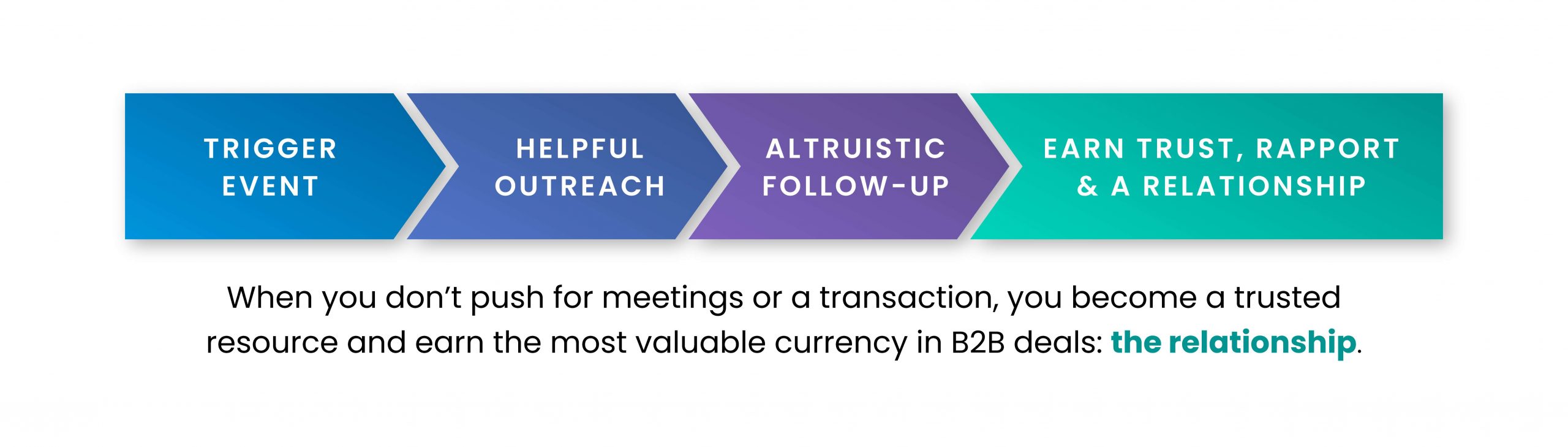
The right response to a trigger is building relevance and rapport. Outreach that lands well shows the buyer that someone noticed what changed and brought something useful to the inevitable challenges that come along with such a change.
For example, let’s say a new CXO arrives, and the outreach acknowledges what’s likely on their plate in the first 100 days. It offers something useful and asks for nothing.
In another scenario, let’s say a company misses an earnings call, and the follow-up comes two weeks later, after the dust has settled, with a relevant case study illustrating a path toward a solution.
Or a semiconductor cost spike hits an industry, and the most exposed companies receive a thoughtful piece of content about how peers are absorbing the shock, attached to a name they can reach if it would help.
What the buyer experiences is a company that noticed, understood, and helped, but didn’t pounce. That experience leaves a powerful positive impression. By the time the buyer is actually ready to evaluate vendors, the company that built familiarity without ever pushing for a meeting is at the forefront of the C-suite’s memory, in a positive light, and on the short list before the short list exists.
BUILDING A TRIGGER MONITORING SYSTEM
The infrastructure for building a mechanism to monitor for trigger events is more accessible than most revenue leaders assume.
First, gather the components, including:
- A defined list of triggers that matter for the specific businesses your company targets, such as executive changes for relationship-led sales, regulatory shifts for compliance solutions, M&A activity for integration tools, etc.
- A monitoring layer that catches them, such as intent data platforms, news monitoring tools, LinkedIn alerts, and structured tracking of target accounts
- A relationship-centric (not meeting- or sales-centric) response playbook calibrated to the trigger and the buyer’s likely state of mind
- A measurement layer that tracks relationship depth and buyer progress alongside any meeting-volume metrics
The infrastructure is the first step. The harder part comes next: connecting the trigger to messaging that’s genuinely relevant to the account it reaches.
Most teams skip this step and default to a templated cadence the moment a trigger fires, and that shortcut shows. A message that tells a prospect “you’re in the financial services industry” lands differently than a message acknowledging that the prospect serves the financial services industry. The distinction seems small, but it’s the difference between a message that demonstrates real account intelligence and one that reveals a generic list pull.
Building this layer of relevance takes deeper thinking than most teams want to apply, since it requires connecting the trigger, the account’s actual business, and the right voice for that moment rather than assuming a trigger alone is enough to justify outreach.
Finally, teams need to establish the discipline of not pushing for meetings or sales once a trigger event occurs. Symptoms of pipeline problems invite reactive sales, but trigger events invite something different: a reason to show up as a resource before the buyer ever asks for one.
THE PAYOFF IN YOUR PIPELINE
Companies that intercept early without pushing have a structural advantage that compounds.
They’re present when the buyer first considers the category, useful when the buyer is doing research, familiar by the time the buyer is willing to engage, and trusted when the buyer finally has budget. Displacing such a well-positioned company requires another vendor to do the same thing earlier and better, which almost never happens.
Symptoms of pipeline problems invite reactive sales, but trigger events and understanding the minds of the decision-makers going through those trigger events reward patient companies that have the mature mindset today’s buyers demand.
The companies that survive and thrive in the next several years of enterprise B2B will be the ones that build the trigger discipline now while the rest of the market is still reacting to the symptoms on the dashboard.

The B2B Buyer Journey Has Changed in the AI Era
In complex B2B sales, success demands proven frameworks and disciplined processes that turn intention and vision into results.

Build It or Buy It
How do we build a deeper level of trust and long-term relationships?